The Australia Time difference to Kenya is between five and eight hours, depending on your city and the season. Kenya is 8 hours behind Sydney during daylight saving and 5 hours behind Perth year-round because Kenya does not observe daylight saving and remains on UTC+3.
This guide provides a city-by-city breakdown of the time difference for both standard and daylight saving periods. It also includes practical advice for managing calls home and mitigating jet lag on your journey from Australia.
How Kenya's Fixed UTC+3 Compares to Australia Time Zones
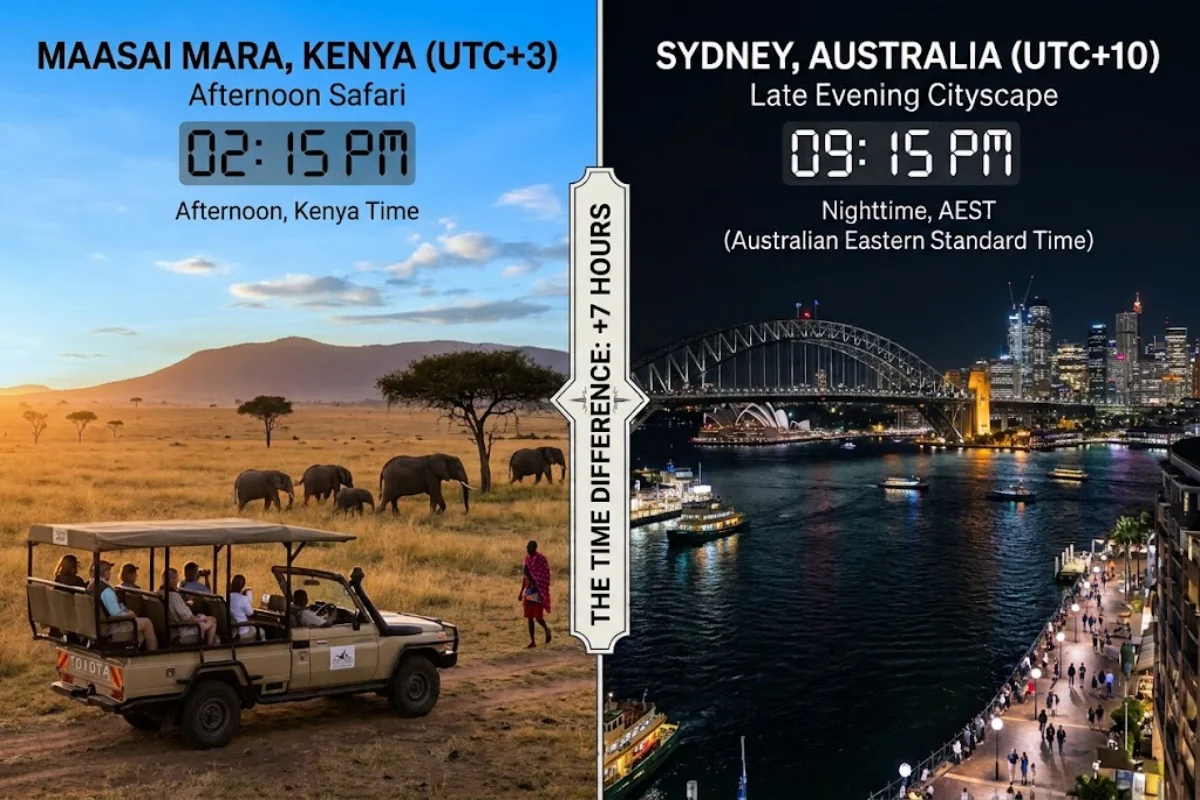
Kenya's time difference to Australia varies because Kenya uses a single, fixed time zone while Australia uses multiple, seasonally-changing zones. Kenya observes East Africa Time (EAT), a constant UTC+3 with no daylight saving.
Australia divides into three main time zones during its standard time period: Australian Eastern Standard Time (AEST) at UTC+10, Australian Central Standard Time (ACST) at UTC+9:30, and Australian Western Standard Time (AWST) at UTC+8. The time gap to Kenya fluctuates further when New South Wales, Victoria, South Australia, Tasmania, and the ACT observe Daylight Saving Time.
Exact Kenya to Australia Time Differences by City and Season
The table below details the exact time difference between Nairobi (UTC+3) and all Australian capital cities. The time gap changes for daylight saving-observing states in early October and early April each year.
| Australian City | Time Difference (Oct–Apr / DST) | Time Difference (Apr–Oct / Standard) |
|---|---|---|
| Sydney (NSW) | Kenya is 8 hours behind | Kenya is 7 hours behind |
| Melbourne (VIC) | Kenya is 8 hours behind | Kenya is 7 hours behind |
| Canberra (ACT) | Kenya is 8 hours behind | Kenya is 7 hours behind |
| Hobart (TAS) | Kenya is 8 hours behind | Kenya is 7 hours behind |
| Brisbane (QLD) | Kenya is 7 hours behind | Kenya is 7 hours behind |
| Adelaide (SA) | Kenya is 7.5 hours behind | Kenya is 6.5 hours behind |
| Darwin (NT) | Kenya is 6.5 hours behind | Kenya is 6.5 hours behind |
| Perth (WA) | Kenya is 5 hours behind | Kenya is 5 hours behind |
What the Time Difference Means for Your Safari Activities

Understanding the time difference helps you manage expectations for communication during your safari. Travellers often plan to call home during an early morning game drive or over evening drinks at the lodge.
Early Morning Game Drive (6:00 am in the Maasai Mara): As you search for predators in the cool morning air, your family in Sydney or Melbourne is finishing lunch at 2:00 pm (during their summer). In Perth, the time is 11:00 am, which is part of a standard workday.
Sundowners on the Savannah (6:30 pm in Amboseli): While you enjoy a drink watching elephants, it is already the next day on Australia's east coast. The time would be 2:30 am in Sydney and Melbourne, and 11:30 pm in Perth, making this a poor time to call home.
Best Times to Call Australia from a Kenya Safari
Most safari lodges and high-end camps provide complimentary Wi-Fi, which is usually concentrated in the main lounge area. The connection speed can be slower than at home, but it typically supports messaging apps like WhatsApp or FaceTime Audio.
The most convenient window for calling Australia is during your afternoon downtime in Kenya, between 3:00 pm and 6:00 pm. This break between your lunch and evening game drive aligns well with evening hours in Australia.
Calling Eastern Australia (NSW, VIC, ACT, TAS, QLD)
A 4:00 pm call from Kenya reaches Sydney, Melbourne, Canberra, or Hobart at midnight during their daylight saving period, or 11:00 pm during standard time. An earlier call from Kenya around 2:00 pm (10:00 pm or 9:00 pm at home) may be more convenient. For Brisbane, 4:00 pm in Kenya is 11:00 pm all year, providing a reliable window for a call.
Calling Central Australia (SA, NT)
A 4:00 pm call from your camp connects to Adelaide at 11:30 pm during daylight saving or 10:30 pm during standard time. The time in Darwin remains constant, with a 4:00 pm Kenya call reaching them at 10:30 pm.
Calling Western Australia (WA)
Perth is the easiest city to coordinate calls with. Your 4:00 pm in Kenya is their 9:00 pm, which is an ideal time for a relaxed conversation about your day's wildlife sightings.
Does the Time Difference Impact Jet Lag to Kenya?

The time difference has a positive impact on jet lag for Australian travellers. Flying west to Kenya means you travel "with the sun," which lengthens your day and makes adjusting to the new time zone easier.
Most people find it easier to stay awake longer to adapt, rather than forcing sleep when their body clock is out of sync. You will likely feel tired from the long flight upon arrival in Nairobi but should not experience severe jet lag.
The most effective strategy is to adapt to local time immediately by staying active in natural light. A gentle first day helps reset your circadian rhythm, such as a visit to Nairobi National Park instead of a long road transfer immediately after landing.
A well-organised itinerary times your first game drive around your arrival to minimise the impact of travel fatigue. You can find more strategies in our guide to overcoming safari jet lag as an Australian traveller or discuss itinerary pacing with a safari specialist.
Why Kenya Does Not Use Daylight Saving
Kenya does not use daylight saving because its location on the equator results in consistent daylight hours year-round. Sunrise and sunset times in Kenya have very little seasonal variation, with approximately 12 hours of daylight each day.
Without a significant shift in daylight, there is no practical reason to adjust the clocks. This consistency makes Kenya's UTC+3 time zone a stable reference point for calculating the time difference to Australia.
Australia's Daylight Saving Dates for 2026-2027
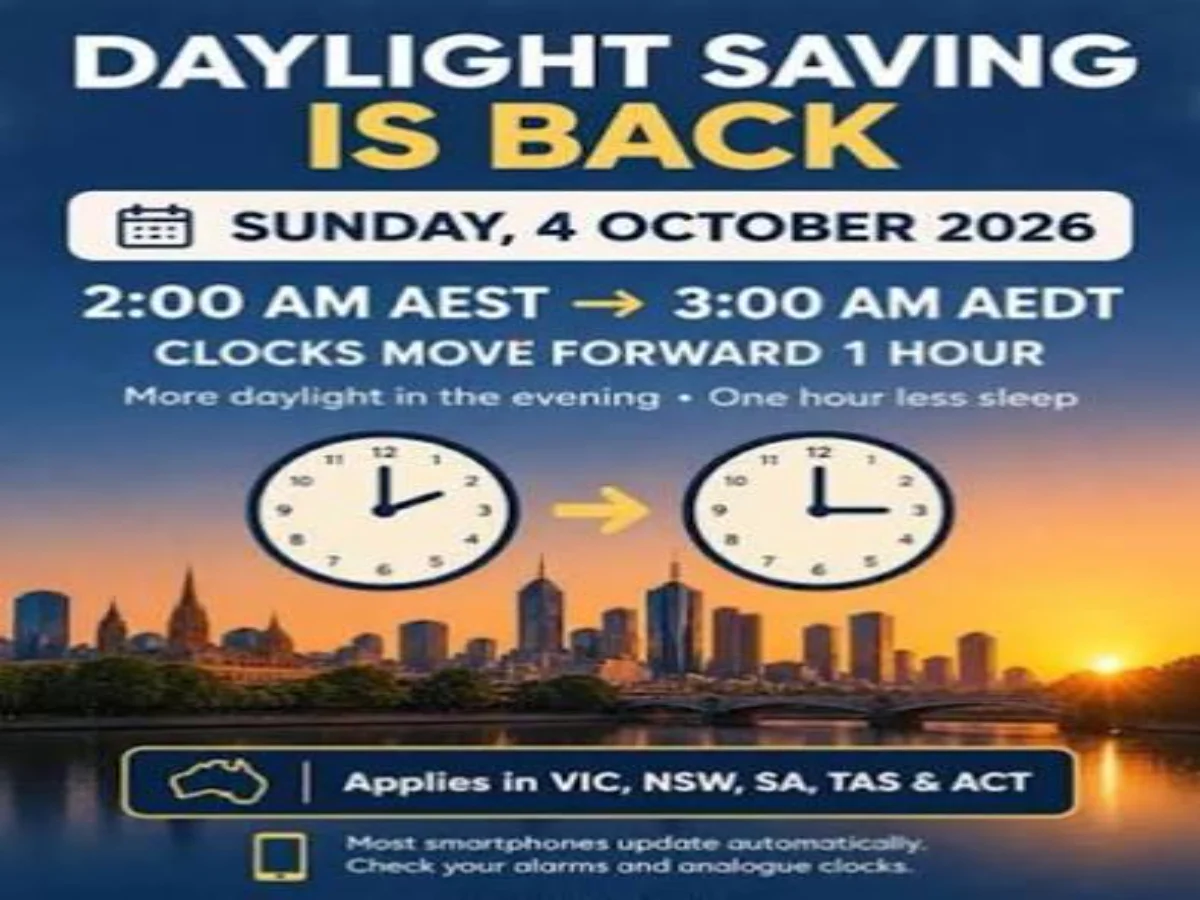
For the 2026–2027 period, Australian Daylight Saving Time begins at 2:00 am on Sunday, 4 October 2026, when clocks move forward one hour. Daylight saving ends at 3:00 am on Sunday, 4 April 2027, when clocks move back one hour.
These changes apply to NSW, VIC, SA, TAS, and the ACT. The time difference to Kenya for QLD, WA, and the NT remains constant all year, as these states do not observe daylight saving.
Key Time Difference Facts for Australian Travellers
| Fact | Details |
|---|---|
| Kenya Time Zone | UTC+3 (East Africa Time) all year |
| Daylight Saving | Kenya does not observe daylight saving |
| Gap to Sydney/Melbourne | 7 hours behind (Standard) / 8 hours behind (DST) |
| Gap to Perth | 5 hours behind all year |
Frequently Asked Questions About Kenya and Australia Time
Is Kenya ahead of or behind Australia?
Kenya is always behind Australia. The exact number of hours varies from 5 to 8, depending on which Australian city you are in and the time of year due to Australia's observance of daylight saving in some states.
Does the time gap change in April and October?
Yes. The time difference changes for New South Wales, Victoria, South Australia, Tasmania, and the ACT on the first Sunday of April (when daylight saving ends) and the first Sunday of October (when it begins). The gap to Queensland, WA, and the NT remains constant year-round.
What time zone is Nairobi?
Nairobi, and all of Kenya, is in the East Africa Time (EAT) zone, which is Coordinated Universal Time +3 (UTC+3). Kenya does not have daylight saving, so its time is constant throughout the year.
How can I quickly convert Kenya time to my Australian local time?
The simplest method to convert Kenya time is to use your smartphone's world clock feature. Add both Nairobi and your home city to see the current times side-by-side, which automatically accounts for Australian daylight saving.
For a quick mental calculation, remember your city's standard time difference (e.g., Sydney is 7 hours ahead) and add one hour if you are travelling during Australia's daylight saving months (October to April).