Looking at Perth to Nairobi flights for a Kenya safari? It involves more than just booking an international flight? Australian travellers must coordinate flights through Johannesburg, understand South Africa's transit and health requirements, obtain the correct Kenyan travel authorisation, arrange onward transport to safari destinations and prepare for baggage restrictions on smaller aircraft.
The Johannesburg route offers a direct flight from Perth to South Africa, followed by an onward connection to Nairobi. However, the practical requirements depend on the ticket structure, flight schedule, length of transit, passport, safari itinerary and whether the traveller remains airside in Johannesburg.
Comparing Perth to Nairobi Flight Routes and Journey Times
The best flight path from Perth to Nairobi depends on your travel priorities. The Johannesburg connection offers the most direct geographical path and often the shortest travel time. The Mauritius route provides an excellent opportunity for a Kenya safari and beach packages. Flights via Gulf hubs offer the greatest schedule flexibility due to high-frequency services. The table below provides a high-level comparison of these options.
| Route Option | Key Airlines | Typical Elapsed Time | Baggage Check-In | Stopover Potential | Best For |
|---|---|---|---|---|---|
| Via Johannesburg (JNB) | South African Airways; Qantas | 15 - 24 hours | Through-checked on SAA single ticket | Possible, but has Yellow Fever implications | Time-efficiency and the most direct path. |
| Via Mauritius (MRU) | Air Mauritius | 20 - 28 hours | Through-checked on single ticket | Excellent; the main reason to choose this route | Honeymoons, families, and 'bush and beach' holidays. |
| Via a Gulf Hub (DXB/DOH) | Emirates; Qatar Airways | 19 - 26 hours | Through-checked on single ticket | Excellent; hubs are built for stopovers | Schedule flexibility from high flight frequency. |
Understanding the Perth–Johannesburg–Nairobi route

The journey has three main stages:
-
Perth to Johannesburg: Fly from Perth Airport (PER) to O.R. Tambo International Airport (JNB) on Qantas's direct service, subject to the operating schedule and availability on your dates.
-
Johannesburg to Nairobi: Connect to a separately operated flight to Jomo Kenyatta International Airport (NBO), using a suitable itinerary offered by an airline such as Kenya Airways or another carrier serving the route.
-
Nairobi to the safari destination: Continue by road or, where available and appropriate, by domestic flight from Nairobi to the relevant reserve or national park.
Qantas announced its direct Perth–Johannesburg service, QF65, with three weekly departures on Tuesdays, Fridays and Sundays when the route launched in December 2025. The published flight duration was approximately 11 hours and 15 minutes. These are route-launch details, not a guarantee of the operating days or timings for every future travel date. Check the current timetable before booking.
How to plan the international connection
The onward flight from Johannesburg to Nairobi must be coordinated with the arrival of the Perth flight. A suitable itinerary needs enough time for the applicable arrival, transfer, security, boarding and baggage procedures.
Before purchasing, establish whether the flights are issued on one through-ticket or as separate bookings. Do not assume that flights sold by different airlines are automatically connected or that a partner airline's flight number means the airlines share responsibility for the whole journey.
Ask the airline or travel agent to confirm:
-
Whether both flight sectors are on one ticket or separate tickets.
-
Whether the checked baggage will be tagged through to Nairobi.
-
Whether you must collect and recheck baggage in Johannesburg.
-
Whether the connection is protected if the inbound flight is delayed.
-
Whether you must pass through South African immigration and customs.
-
Whether the itinerary requires an overnight stay in Johannesburg.
-
What assistance or alternative arrangements apply if a connection is missed.
A single through-ticket can simplify a connecting journey, but its exact baggage arrangements, minimum connection time and disruption protection must be confirmed for the particular itinerary.
Choosing between a through-ticket and separate flight bookings
The distinction between ticket types is one of the most important practical considerations when travelling via Johannesburg.
Option A: One through-ticket to Nairobi
Where an airline or authorised travel agent offers an itinerary from Perth to Nairobi on one ticket, confirm the complete routing and operating carriers before paying.
Potential advantages include coordinated reservations and the possibility of through-checked baggage. If a disruption causes a missed connection, the applicable ticket conditions determine what rebooking assistance is available.
Do not assume that a particular South African Airways flight number, codeshare or partner arrangement is currently available. Check the actual booking results and ticket conditions for the intended dates.
Option B: Separate Perth–Johannesburg and Johannesburg–Nairobi tickets
Separate bookings can provide flexibility in choosing airlines, but they may transfer more connection risk to the traveller.
If baggage is not checked through and the traveller must enter South Africa to collect it, they must meet the applicable South African entry requirements. They may then need to collect their luggage, clear customs, reach the relevant check-in area, satisfy the onward airline's document and baggage requirements, and pass through security and departure controls.
A traveller should not assume that they can simply remain in the international transit area when the itinerary requires baggage collection or a new check-in.
Allow a conservative connection period, particularly where the tickets are separate. An overnight stay can be more practical than a tight connection if the available flight schedules do not provide a comfortable margin.
Booking principle: Obtain written confirmation of baggage handling, connection protection and the need to enter South Africa before deciding between ticket options.
What happens at O.R. Tambo International Airport?
Johannesburg's O.R. Tambo International Airport is the connecting airport for this itinerary. The process you follow depends on the itinerary and the airport's applicable procedures.
If you remain in international transit
If both flights are properly connected and your baggage is checked through, you may be able to remain in the designated international transit area and follow the airport's transfer procedures.
Being airside does not mean that every passenger can board the next flight automatically. You must still satisfy the onward airline's requirements and follow airport instructions.
If you must enter South Africa
If the airline requires you to collect baggage, check in again landside or leave the transit area, you must meet South Africa's applicable immigration requirements.
Before booking, verify the entry rules for your passport nationality and circumstances with the South African authorities. Australian passport holders should consult the South African Department of Home Affairs and the Australian Government's South Africa travel advice.
South Africa's online traveller declaration: the 2026 change
From 1 July 2026, South Africa introduced an online traveller declaration requirement for travellers entering or leaving the country. The South African Revenue Service states that air and sea passengers who are only transiting and do not leave the designated transit area are excluded from submitting the traveller declaration.
For travellers who enter or leave South Africa, the declaration generally needs to be submitted no more than 24 hours before departure from the country. Travellers who have not completed it beforehand are not automatically denied entry or departure solely for that reason; customs officials and airport facilities can assist.
Yellow fever vaccination and the Johannesburg transit
Yellow fever documentation requires particular attention on the return journey from Kenya.
Kenya is a yellow fever risk country, and South Africa's official guidance identifies Kenya among the countries associated with yellow fever vaccination certificate requirements. South Africa's rules include requirements for travellers arriving from risk countries and, in specified circumstances, people who have spent more than 12 hours transiting through an airport in a yellow fever risk country.
The exact requirement can depend on the route, the traveller's recent travel history, the length of transit and whether the traveller enters South Africa. Do not assume that an airside connection automatically removes all yellow fever documentation requirements.
What Australian travellers should do
-
Arrange a travel-health consultation well before departure.
-
Discuss yellow fever vaccination for the Kenya itinerary and the requirements for the South African connection.
-
Obtain and retain the official International Certificate of Vaccination or Prophylaxis (ICVP) if vaccinated.
-
Confirm the certificate requirements for both the outbound and return itineraries with the airline and relevant government authorities.
-
Check whether any medical exemption or special circumstance applies before travelling.
South African guidance states that travellers required to present a yellow fever certificate must have a valid certificate. A vaccination administered less than 10 days before the relevant journey may not meet the validity requirement for first-time vaccination.
The World Health Organization's International Health Regulations provide for the international validity of a yellow fever certificate for the lifetime of the vaccinated person after a valid vaccination. Check that the certificate and the vaccination record meet the applicable rules.
Kenyan entry requirements for Australian passport holders
Australian travellers visiting Kenya for a safari must arrange the correct travel authorisation before departure.
Electronic Travel Authorisation (eTA)
The Kenyan government requires most foreign visitors, including Australian tourists, to obtain an approved Electronic Travel Authorisation before travelling to Kenya. The official eTA process includes infants and children who require authorisation.
Apply through the official Kenyan government portal:
Kenya Electronic Travel Authorisation
The application process asks travellers to prepare documents and information including:
-
A passport valid for at least six months after the planned arrival date, with at least one blank page.
-
A passport-style photograph or selfie.
-
Contact details.
-
Arrival and departure itinerary details.
-
Accommodation booking confirmation.
-
A payment method.
Additional documentation can depend on the purpose of travel and individual circumstances. An application is not the same as an approval, so check the status and ensure authorisation has been granted before starting the journey.
The Kenyan government states that eTA validity for travel is 90 days from the date of issue. The period of stay is determined on arrival.
Travel health insurance
As of October 2026, the Australian Government's Kenya travel advice states that mandatory inbound travel health insurance has been integrated into the Kenyan eTA application process.
Travellers should review the insurance offered or required through the application and confirm its coverage, exclusions and limits. It should not automatically be treated as a replacement for comprehensive travel insurance.
Australian travellers should obtain additional cover appropriate to the trip, including medical treatment, emergency evacuation, cancellation, interruption, baggage and planned activities where applicable.
Passport and travel documents
Carry the passport used for the eTA application and keep accessible copies of the travel authorisation, accommodation details, onward or return booking and travel insurance information.
If you hold more than one nationality, or intend to travel on a passport other than an Australian passport, verify the requirements for that passport rather than relying on the rules for Australian citizens.
Yellow fever and other health preparations for Kenya

Yellow fever, malaria and other insect-borne diseases are important health considerations for a Kenyan safari.
The Australian Government advises travellers to Kenya to seek appropriate medical advice, consider recommended vaccinations and carry relevant vaccination documentation. It identifies malaria as widespread in Kenya except in Nairobi and locations above 2,500 metres, and advises travellers to consider anti-malarial medication.
A safari itinerary can include several environments, including Nairobi, lower-altitude wildlife reserves and coastal areas. Health recommendations should therefore be based on the actual itinerary rather than a general assumption that all destinations carry the same risks.
Before departure:
-
Consult a qualified travel-health clinician, ideally six to eight weeks before travel where possible.
-
Discuss yellow fever vaccination and documentation.
-
Ask about malaria prevention and any prescribed medication appropriate to the itinerary.
-
Review routine vaccinations and other destination-specific health advice.
-
Carry prescribed medicines in their original packaging where practical, with a copy of the prescription and relevant medical documentation.
-
Pack insect repellent and suitable clothing.
-
Confirm that your accommodation and planned activities are covered by your insurance.
Baggage planning for international and domestic flights
International checked baggage allowances and domestic safari-flight limits are not necessarily the same.
The international airline determines the baggage allowance for the ticket, fare class and operating carrier. Travellers should check the baggage information displayed for each sector and verify the rules if more than one airline operates the itinerary.
A general statement that every international airline allows 23–30 kg is not sufficiently reliable for planning a particular journey.
Small aircraft used for safari transfers
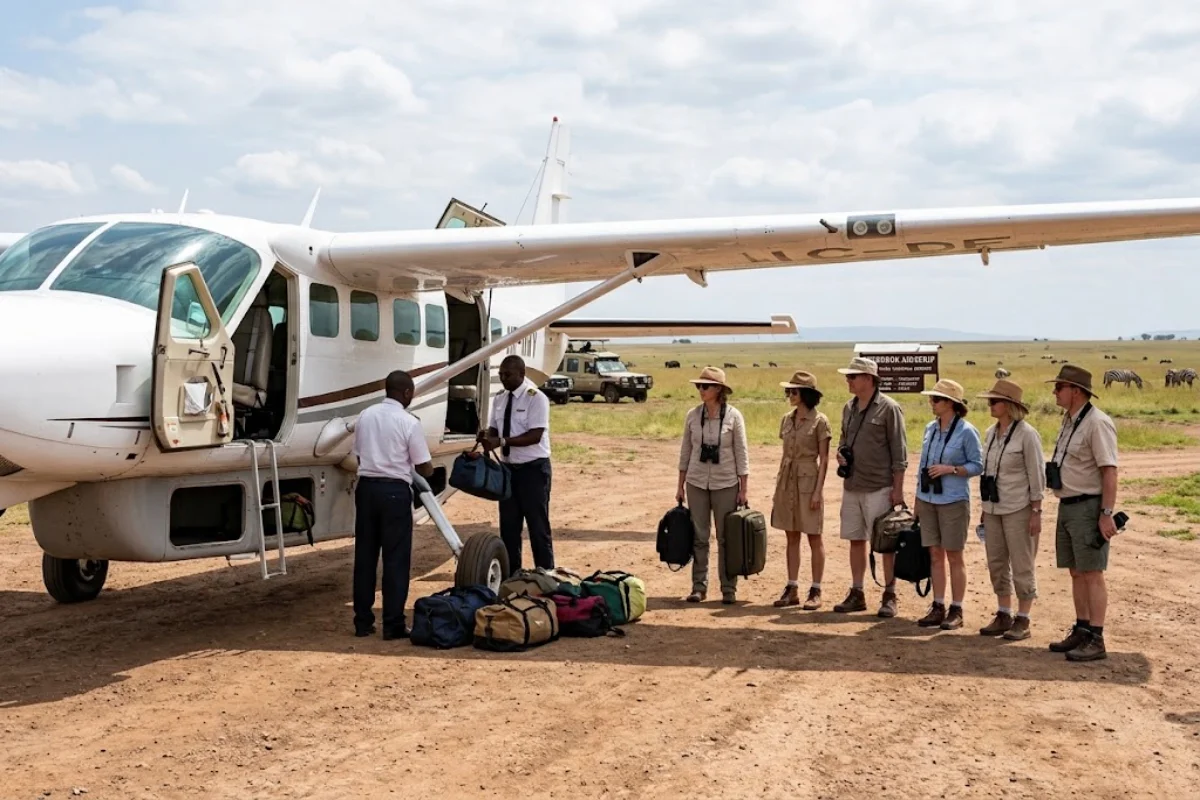
Some safari itineraries use smaller aircraft to reach remote airstrips near reserves and camps. These services may impose lower weight limits and restrictions on bag dimensions or construction.
A 15 kg soft-sided bag limit is common on some safari-flight itineraries, but it is not a universal rule for every airline, route or aircraft. The operator's current conditions determine the actual limit, including whether hand luggage is included.
Before packing, contact Kenya safari holiday planners to confirm:
-
The maximum total baggage weight per passenger.
-
Whether hand luggage counts towards that limit.
-
The permitted bag dimensions.
-
Whether soft-sided luggage is mandatory.
-
Whether camera equipment, binoculars or other special items have separate conditions.
-
Whether excess baggage can be carried, and at what cost.
-
Whether larger suitcases can be stored securely in Nairobi or at the relevant hotel.
If the safari flight has a strict baggage allowance, plan the international luggage around that restriction. Arrange any storage in advance rather than assuming it will be available on arrival.
For trip preparation, see the Kenya Safari Trails packing lists.
Nairobi arrival: airport transfers and the first night
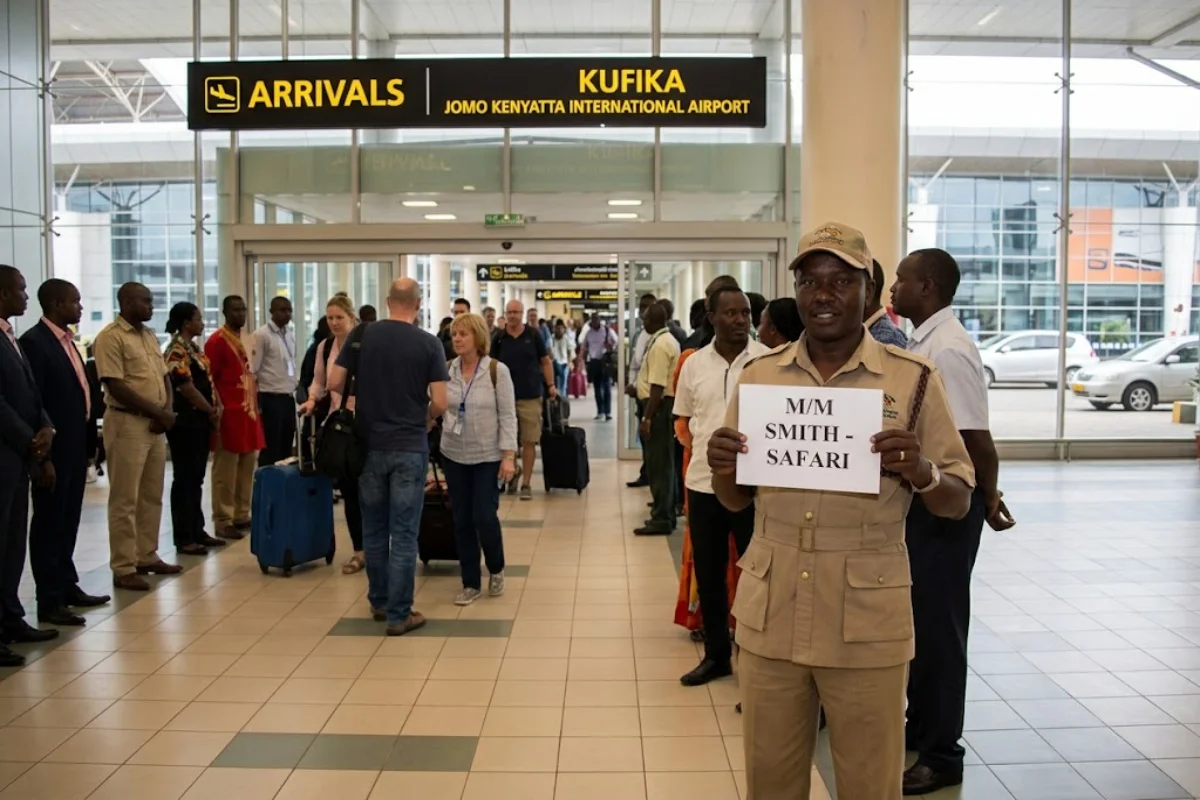
International travellers arriving at Jomo Kenyatta International Airport should allow time for the arrival formalities, baggage collection where applicable, and the transfer to their accommodation.
Do not plan a tightly timed safari departure immediately after an international flight unless the complete itinerary has been checked and the relevant operators have confirmed that the connection is workable.
Nairobi's two relevant airports
Jomo Kenyatta International Airport (NBO) handles the international arrival in this itinerary. Wilson Airport (WIL) serves many domestic and regional flights, including services used for safari connections.
If your safari begins with a flight from Wilson Airport, the transfer between NBO and WIL is a separate ground journey. The actual travel time depends on traffic, road conditions and the time of day. A fixed estimate should not be treated as a guaranteed transfer duration.
A practical itinerary should include:
-
Arrival at NBO.
-
Immigration, baggage and customs procedures as applicable.
-
A pre-arranged transfer to a hotel or other confirmed accommodation.
-
An overnight stay when the international arrival and safari departure schedules make a same-day connection impractical.
-
A separate transfer to WIL if the next flight departs from there.
An overnight stay provides a buffer against delays and reduces the risk of missing a separately booked domestic flight. The right arrangement depends on the actual arrival time and the next day's confirmed departure.
If your itinerary continues by road, confirm the pickup location, journey duration and planned departure with the safari operator.
Booking internal transport to safari destinations
The appropriate onward transport depends on the safari destination and the itinerary sold by the operator.
Some destinations are reached by road, while others may be served by domestic flights to airstrips near the reserve or camp. Not every camp has the same transport options.
Before finalising international flights, confirm:
-
The safari's actual starting point.
-
Whether the transfer is by road or aircraft.
-
The departure airport for any domestic flight.
-
The time required to reach that airport.
-
The domestic flight's baggage rules.
-
Whether transfers are included in the safari package.
-
What happens if an international flight delay causes you to miss a separately booked transfer.
Where a safari uses domestic flights, coordinate the international arrival with the domestic booking before paying for non-refundable services.
Kenya's national parks and reserves also have applicable entry and payment procedures. The Australian Government advises visitors that access fees for national parks are handled through the relevant Kenyan eCitizen arrangements. Confirm the applicable fees and payment instructions for the specific parks in your itinerary.
Travel insurance for the full Perth–Johannesburg–Kenya journey
Travel insurance should reflect the entire trip rather than Kenya alone.
Australian Government advice recommends comprehensive travel insurance that covers overseas medical treatment and evacuation. Travellers should check policy exclusions and ensure cover applies to every country visited or transited, including South Africa if the itinerary or a planned stopover requires it.
Before purchasing a policy, verify:
-
Medical expenses and emergency medical evacuation.
-
Cancellation and trip interruption.
-
Missed connections and travel delays, subject to the policy terms.
-
Baggage loss, theft and damage.
-
Cover for safari activities and any additional adventure activities.
-
Any relevant pre-existing medical condition exclusions.
-
Whether an overnight stopover or a change in route affects coverage.
A missed connection caused by a delay on a separately booked ticket may be treated differently from a missed connection on a protected through-ticket. Do not assume the insurer will reimburse every additional hotel, flight or transfer cost.
Returning from Kenya to Perth via Johannesburg
The return journey deserves as much preparation as the outbound trip.
A traveller departing Nairobi may have to check in for the international flight, comply with the operating airline's document checks, and follow the applicable transit or entry procedures at Johannesburg before boarding the Perth flight.
Before leaving Kenya, confirm:
-
The correct check-in time for the Nairobi departure.
-
Whether the baggage is checked through to Perth.
-
Whether Johannesburg is an airside connection or requires entry into South Africa.
-
Whether the connection is protected on the ticket.
-
The applicable South African yellow fever documentation requirements.
-
Whether the traveller must submit a South African customs declaration.
-
The operating airline's baggage and cabin-baggage limits.
Yellow fever requirements on the return
Because Kenya is a yellow fever risk country, check South Africa's requirements carefully before returning via Johannesburg. Carry your ICVP if vaccinated and confirm that it meets the applicable entry or transit requirements for the itinerary.
Do not rely solely on the fact that the traveller is an Australian citizen or that the Johannesburg connection is intended to be short.
Entering Australia after Kenya
Australia's yellow fever rules distinguish between vaccination recommendations and entry procedures. The Australian Government states that travellers arriving in Australia must declare if they have visited a yellow fever risk country or area within the previous six days. They may be asked to provide an International Certificate of Vaccination or Prophylaxis.
Australia does not automatically refuse entry to a traveller who has not been vaccinated or cannot prove vaccination. Instead, the traveller may be referred to a biosecurity officer and given instructions to follow if symptoms develop.
Safety and current travel advice
Australian travellers should review the official travel advice for both Kenya and South Africa before departure and again shortly before travelling.
As of 13 October 2026, the Australian Government advises travellers to exercise a high degree of caution in Kenya because of terrorism and violent crime, with higher advice levels applying to specified areas. The advice also identifies potential disruptions from protests, industrial action and severe weather.
South Africa has its own travel and safety considerations. If your itinerary involves entering the country rather than remaining airside, review the current advice and plan accordingly.
For Kenya, use registered and reputable tour operators, follow park regulations and local instructions, and make sure insurance covers the planned safari activities.
Practical checklist before booking
Use this checklist to confirm that the essential arrangements are in place.
International flights and Johannesburg
- Check the current Perth–Johannesburg timetable and fare availability.
Confirm the Johannesburg–Nairobi flight on the intended date.
Establish whether the itinerary is on one through-ticket or separate bookings.
Confirm baggage transfer, connection protection and minimum connection requirements.
Determine whether South African immigration must be cleared.
Check the applicable South African traveller declaration and health requirements.
Verify the return itinerary and any overnight connections.
Kenya entry and health
Obtain approved Kenyan eTA authorisation where required.
Check passport validity and blank-page requirements.
Review the current travel-health advice.
Consult a travel-health clinician about yellow fever and malaria prevention.
Carry relevant vaccination documentation.
Arrange comprehensive travel insurance.
Safari arrangements
Confirm the safari start and end locations.
Book accommodation for the first night where appropriate.
Arrange airport transfers.
Confirm whether onward travel is by road or aircraft.
Verify the baggage limit for every domestic flight.
Arrange secure luggage storage if needed.
Confirm the inclusions, fees and payment procedures for the planned parks and reserves.
Frequently asked questions
Is there a direct flight from Perth to Johannesburg?
Qantas announced its direct Perth–Johannesburg service in December 2025. The published route information specified QF65 operating three times weekly at launch. Always check the current timetable for your intended travel dates.
Can I fly from Perth to Nairobi via Johannesburg on one ticket?
A through-ticket may be available depending on the date, airlines and booking channel. Do not assume a particular South African Airways or partner itinerary is currently available. Check the full booking and ticket conditions to confirm whether the journey is issued as one ticket.
Do I need a South African visa to transit through Johannesburg?
The answer depends on your nationality and whether you remain in the designated transit area or enter South Africa. Australian travellers should confirm the requirements with the South African authorities and the operating airline before booking, especially if baggage collection or a new check-in requires entry into the country.
Do I need yellow fever vaccination for a Kenya safari?
The appropriate vaccination advice depends on the itinerary and individual circumstances. Kenya's health risks and South Africa's requirements on the return route make a travel-health consultation particularly important. Carry the official vaccination certificate if vaccinated and verify the current entry and transit rules for every country on the itinerary.
Is 15 kg the universal baggage limit for Kenya safari flights?
No. The limit depends on the domestic operator, aircraft and route. Some safari flights impose a 15 kg soft-sided baggage limit, but travellers must confirm the exact weight, dimensions and hand-luggage rules with their operator.
Should I fly to a safari destination on the day I arrive in Nairobi?
Only if the actual schedule and transfer arrangements make the connection practical and the operators confirm it. An overnight stay is often a safer planning choice when a delayed international flight could cause a missed domestic departure.